Sunday, August 20, 2017
Monday, August 14, 2017

AMD Vega release date, news and features: everything you need to know
The cards will be known as 'AMD Radeon RX Vega'

Updated: We've had our first taste of what the AMD Radeon RX Vega 64 can do, and you can read our full review of the graphics card here.
At CES 2017, chipmaker AMD officially revealed the first details about its Vega graphics processing unit (GPU) architecture. However, it wasn’t until July 31 that we found out the first Vega cards would ship sometime in mid-August, along with full details of the GPUs.
Cut to the chase
- What is it? The follow-up to AMD’s Polaris GPU architecture
- When's it out? August 14, 2017
- What will it cost? $499 or £549 (about AU$630)

AMD Radeon RX Vega release date
AMD's affordable, consumer-oriented Radeon RX Vega 64 will arrive on August 14, with three versions including a standard edition model, an aluminum-clad limited edition version and a liquid-cooled design with higher clock speeds.
AMD has also announced that the Radeon RX Vega 56, which is positioned to compete with the Nvidia GTX 1070, will arrive on August 28.

AMD Radeon RX Vega price
The AMD Radeon RX Vega 64 will be available as a standalone card for $499 or £549 (about AU$630).
That's a big step up from the Radeon RX 500 lineup, which starts at as low as $169 (about £136, AU$219), but this is meant to be AMD's enthusiast-class grade graphics card. It's been a long-awaited sequel to the company's mostly defunct Radeon R9 Fury X, which was still going for a cool $389 (about £315, AU$505) up until its demise.
What's more, at this price point it's competitive against the $549 (£539, AU$1,299) Nvidia GTX 1080 Founders Edition.
The Vega 64's other two editions have to be bought as part of AMD's new Radeon Packs, which bundle two free games, plus a $200 discount on the 34-inch Samsung CF791 curved ultra-wide FreeSync monitor and $100 off a Ryzen 7 processor and motherboard.
Unfortunately, those hardware discounts will only kick in if users are buying the said monitor and CPU/motherboard combo at the same time as their Vega GPU. Of course, users can choose to not buy the extra components and peripherals while still getting the two free games, confirmed – in the US at least – to be Wolfenstein II and Prey.
The limited-edition AMD Radeon RX Vega 64 will come as part of a Radeon Black Pack for $599 (about £460, AU$750). Meanwhile, the liquid-cooled Vega 64 will run for $699 (about £530, AU$875), and can only be purchased as part of AMD's Radeon Aqua Pack.
Lastly, you'll be able to purchase the AMD Radeon RX Vega 56 by itself for $399 (about £300, AU$500). Alternatively, the $499 (about £380, AU$625) Radeon Black Bundle includes the same discounts and free games as above.
All things considered, Vega is shaping up to be as competitive to Nvidia as Ryzen is to Intel – even if buying graphics cards in a bundle isn’t exactly ideal. For the sake of the industry, we could see Nvidia discount its GPUs in order to remain ahead of the curve in terms of value.

AMD Radeon RX Vega specs
Following its 2017 Capsaicin 2 livestream event, AMD revealed the exact specifications for its two new Vega GPUs, as well as its underlying Vega 10 architecture.
From the chart above, it's clear the most powerful of the bunch will be the liquid-cooled version of the Radeon RX Vega 64. The more expensive water-cooled version will operate at higher base/boost clocks, despite sharing identical specs to its air-cooled twin.

The RX Vega 56, on the other hand, is positioned against Nvidia’s GeForce GTX 1070 at $400 (about £305, AU$505). However, early benchmarks have cited performance that greatly outweighed that of its closest competition while running triple-A games at 2560 x 1440.
Like the Polaris 10 architecture that preceded it, AMD's Polaris 10 architecture is built on an 14nm FinFET process that should ultimately make it more power-efficient and robust in performance.

Vega 10 is also noticeably skewed towards delivering on more compute power than raw graphical strength like Nvidia's Pascal GPUs. This will likely mean Vega will be able to better handle the complex calculations of procedural surfaces, volumetric lighting and the overall quality of the in-game graphics.
This era of Vega GPUs also ditches GDDR5 memory altogether for a new format known as HBM2, or high-bandwidth memory. AMD believes its efficient memory offers a 75% smaller footprint than GDDR5 while also being 3.5 times more power-efficient.
AMD also claims that Vega’s high-bandwidth cache controller will improve maximum frame rates by 50% and minimum frame rates by 100% over GDDR5 memory.
Interestingly, Vega 10 is also designed to support up to 16GB of HBM2 memory – which we've already seen from Radeon Vega Frontier Edition – so Nvidia's Titan X may finally get some competition from AMD.
Stay tuned for more details regarding everything AMD Vega, as we'll be updating this page with the latest as it happens. In the meantime, be sure to update to the latest version of AMD Radeon Software Crimson ReLive for a generous helpingof GPU control features.
Gabe Carey also contributed to this article
Best gadgets 2017: the top tech you can buy right now
Best gadgets 2017: the top tech you can buy right now


For when only the best is good enough
You may never have heard of choice paralysis, but you'll definitely have been affected by it. It's that sensation you experience when you know you want something, say an ice cream, but there are so many flavors to choose from that you end up not buying one at all, and going ice cream-less. That's choice paralysis. And the tech world is full of it.
For every gadget and gizmo there are hundreds of different makes and models. Making a decision is hard. So, to cut through some of the confusion, we've collated our 'best of the best' gadgets list.
This list only features one item in each category, and that item is what we currently think is the best of its kind. The products on this list will only change when something better comes along and knocks a reigning champ off its top spot.
If you’re the sort of person who wants to have the best of everything, this is your ultimate shopping list…
Best phone
Samsung Galaxy S8
The best smartphone in the world – it's a work of art
Weight: 155g | Dimensions: 148.9 x 68.1 x 8mm | OS: Android 7 | Screen size: 5.8-inch | Resolution: 1440 x 2960 | CPU: Exynos 8895 | RAM: 4GB | Storage: 64GB | Battery: 3000mAh | Rear camera: 12MP | Front camera: 8MP
Best laptop
Dell XPS 13
The Dell XPS 13 is the best laptop money can buy
CPU: Intel Core i3 – i7 | Graphics: Intel HD Graphics 620 | Screen: 13.3-inch FHD (1,920 x 1,080) – QHD+ (3,200 x 1,800) | Storage: 128GB – 512GB SSD
Best TV
Samsung Q9F QLED
These spectacularly bright TVs reveal the full majesty of the latest HDR content
Screen sizes available: 65-inch now, 75-inch (US) later in the year, 88-inch (Europe) later in the year | Tuner: Freeview HD | 4K: Yes | HDR: Yes (HDR10, HLG/HDR10+ via upcoming firmware update) | Panel technology: LCD with horizontal edge LED lighting, local dimming and Samsung’s new QLED Quantum Dot technology | Smart TV: Yes, Samsung’s Eden interface | Curved: No | Dimensions: 1450 x 829.3 x 24.9mm (W x H x D) | 3D: No | Inputs: Four HDMIs, three USBs, tuner input, Ethernet port, optical digital audio output, PCMCIA slot, Wi-Fi, Bluetooth
Best games console
PS4 Pro
Sony's souped-up PS4 Pro is amazing for 4K TV owners
Dimensions: 29.5 x 32.7 x 5.5 cm (W x L x H) | GPU: 4.20 TFLOPS, AMD Radeon™ based graphics engine | RAM: 8 GB of GDDR5, 1 GB DDR3 | Communication: USB 3.1, HDMI 2.0a, Ethernet, Optical Audio and PlayStation Camera ports, Dual-band 802.11ac wireless, Bluetooth 4.0 | Max Resolution: 3840 × 2160 | Maximum controllers: 4 | Storage: 1TB
Best fitness tracker
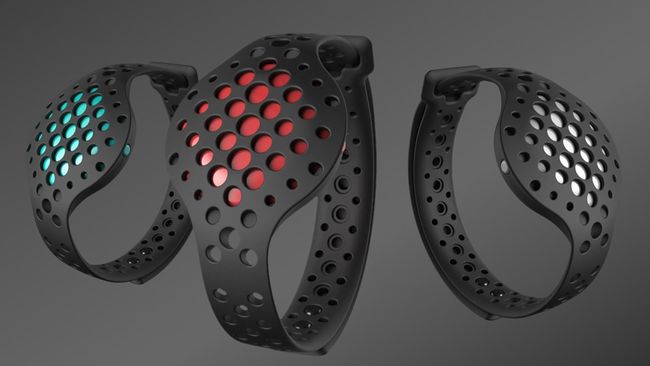
Moov Now
The no-screen wonder
Screen: No | Heart rate tracker: No | Waterproof: Yes | Activity tracking: Yes | GPS: Yes, through phone | Battery life: Six months | Compatibility: Android/iOS
Best camera
Fujifilm X-T2
A stunning camera that's perfect for enthusiast photographers
Type: Mirrorless | Sensor size: APS-C CMOS | Resolution: 24.3MP | Lens: Fuji X mount | Viewfinder: EVF | Monitor: 3.0-inch tilt-angle display, 1,040,000 dots | Maximum continuous shooting speed: 8fps | Movies: 4K | User level:
Cyber Monday 2017: everything you need to know about this year's deals
The hottest deals in tech town

The day commonly known as Cyber Monday traditionally marks the end of the biggest shopping weekend of the year, kicking off with the Thanksgiving holiday moving into Black Friday: after the family celebrations, droves of shoppers hit the high street to pick up any bargains they can get their hands on.
The term "Cyber Monday" was coined more than a decade ago to encourage people to do more shopping online - web retailers offered more discounts, shoppers picked up more stuff, and the cycle has continued to get where we are today.
Last year was another record-breaker, according to the stats: the $3.45 billion that users spent online on Cyber Monday 2016 made it the biggest day in US ecommerce history, according to Adobe Digital Insights.
In the UK a quarter of all consumers were planning to pick up a discounted deal on Black Friday and Cyber Monday last year, and that strong interest shows no signs of abating just yet. Brace yourself for another busy day of online shopping this year.
When is Cyber Monday 2017?
First there's Thanksgiving on the Thursday, then there's Black Friday on the Friday, and then there's Cyber Monday. Cyber Monday 2017 will be on November 27.
Unlike Black Friday, where the focus is traditionally on high street stores as well as online retailers, Cyber Monday is more about shopping on the web. In fact the marketing term was first dreamt up as a way to get people to buy more of their stuff online, at a time when web shopping wasn't as familiar and as straightforward as it is now.
The weekend as a whole is regarded as the last few days of big discounts before Christmas, and so people are often tempted to splurge the cash on gifts for themselves or their friends and family - total spending was reportedly close to £6 billion last year in the UK over Cyber Monday and Black Friday.
It's really all about the timing with Cyber Monday. Shoppers are either back at work after the Thanksgiving break or enjoying an extended holiday, and with so many good discounts on offer, that leads to a lot of browsing and clicking.
If you ever need to work out when Cyber Monday falls, Thanksgiving is always the fourth Thursday in November in the US. While the holiday isn't widely celebrated in the UK, the associated shopping days are now usually carried over the Atlantic.
Why Cyber Monday matters
Cyber Monday drives strong sales for retailers, kickstarting the holiday shopping season, and gives consumers access to some very decent bargains - it's a win-win for both sides, so it's no surprise that Cyber Monday continues to grow in popularity.
And in the opinion of Dom Joseph, CEO of ad tech firm Captify: "What works very much in Cyber Monday's favour is that it is the last significant retail 'day' before Christmas, in which people have the opportunity to pick up a heavily discounted bargain."
You have to acknowledge the influence of Black Friday as well, because without Black Friday there's no Cyber Monday. If you've missed out on the weekend sales or not had time to get online, then you've got Cyber Monday to fall back on, and to a large extent it's about shoppers taking up the last opportunity to land a deal before December starts.
As the fame of Cyber Monday has grown and grown, a lot of consumers are waiting for the day (and Black Friday) to come around to spend their cash. That just makes the battle between the retailers even more competitive, which should lead to more attractive deals for anyone with some buying to do.
Shopping on Cyber Monday 2017
All the usual benefits of online shopping apply to shopping on Cyber Monday 2017: you can do it from the comfort of your own home, you can compare dozens of products and prices in seconds, and you can purchase your goods almost instantly.
There's only one small downside, which is you might not get your gadgets immediately, but even so, with delivery times getting faster and faster and the risk of wasting your time queueing on the high street, many people would consider that a trade-off that's well worth it.
While a few Cyber Monday deals have some kind of time restriction on them, a lot are going to be running all day, stats from previous years show. You don't necessarily have to sneak out of the office to get your order in.
According to the experts, Cyber Monday also sees a broader range of deals across each individual retailer, so it's less about one-off discounts and more about lower prices across the board. That said, some stores will follow-up Black Friday discounts with further reductions on Cyber Monday if they still need to shift some stock.
Saturday, August 12, 2017
Top 45 best free games you should play in 2017

Best free PC games: 7 - 8
7. Star Wars: The Old Republic
Taking over from the original Star Wars MMORPG Star Wars Galaxies in 2011, Star Wars: The Old Republic was not free at release at first. But it has since, like so many games of this kind, adopted the free-to-play model. If you want to get Sith kicks, this is the best way to get them for free.
However, subscriptions are still available, giving you more in-game potential. All the story missions are available without a sub – they just might take you that bit longer.
It's worth the download simply to experience the Star Wars universe from different perspectives, like the hyper-professional Imperial Agent and Bounty Hunter. If you want to go with the dull option and just have a generic Jedi Knight, though, that's fine too.

8. Forza Motorsport 6 Apex
When Xbox head Phil Spencer said he was going to bring the console's best franchises to the PC, he wasn't joking around. Among these notable series is Forza Motorsport.
Shunned by petrol-heads and embraced by gamers, Forza Motorsport may seem like an arcadey offshoot of its biggest rival on PlayStation, but it consistently looks and feels superb nonetheless.
Apex in particular brings a complete Forza Motorsport game to PC players for the first time. Though it’s free-to-play, there is additional content that can be downloaded for a modest price. While it’s not quite the full-fledged experience you can expect on Xbox One, with support for 4K screens and racing wheels, Forza Motorsport 6 Apex is the free-to-play twist we’ve been craving from Microsoft’s long-standing racing series.
Facebook launches Watch, its new platform for original TV shows

No, Facebook didn't make a smartwatch. Say hello to Watch, a new video platform on Facebook featuring original TV shows, including content funded by the mega social network itself.
Launching on Thursday to a small number of users in the US, Watch is a revamped, pumped up version of the US-only Video tab, which it's also replacing. Through Watch, Facebook will serve up video content on iOS, Android, desktop, laptop and its TV applications.
Just like a typical television program, Watch shows will center on a theme or story line. These won't be user-generated Facebook Live broadcasts, but rather professional-grade productions, including from the likes of A&E, National Geographic, the NBA and Time Inc., according to Variety. Some shows, of course, will be done live, or include live segments.
Conde Nast Entertainment also alerted TechRadar on Wednesday to its five-episode Facebook Watch show, called Virtually Dating, which is slated to launch later this month.
Facebook Watch's Android app interface
Every show on Watch includes a comment section, letting you follow the conversation and engage with your own hot take. This brings a social element to the mix, though live chat is a feature we've already seen on YouTube.
You'll be able to keep tabs on your favorite programs through the Watchlist, and scope what your friends are tuning into or explore categories like "Most Talked About" and "What's Making People Laugh" to discover more shows.

What's on Facebook tonight?
Watch isn't just about passively viewing and commenting once in a while; it's above all else a platform for creators to share a variety of content, much in the same way as YouTube.
However, to start with Facebook is limiting its Watch content creators to a small set of publishers. Eventually, the company plans to open it up and allow others to make shows, and people hoping to do so can "register your interest in creating a show" here.
Facebook detailed the kinds of content it thinks will do well, breaking it down into a few categories as detailed in a blog post: shows that engage with fans and community, live shows that connect directly with fans, shows that follow a narrative arc or have a consistent theme, and live events that bring communities together.
The only Facebook-funded show named in its announcement is Returning the Favor with Mike Rowe, of Dirty Jobs fame.
This last bit goes directly after other services' sports ambitions, as Facebook will broadcast one Major League Baseball game every week. Twitter previously live streamed Thursday night NFL games, however, it recently lost those rights to Amazon. Twitter now broadcasts a number of live programs throughout the day, including sports.
As for the content it's backed, Facebook's aim is to basically provide examples of what it thinks will work on Watch. Facebook tells us that, while it's funding some shows directly right now, it will eventually cut back on the number as more come to the fore.
The only Facebook-funded show named in its announcement is Returning the Favor with Mike Rowe, of Dirty Jobs fame. Rowe finds people who are "doing something extraordinary for their community," and in turn he'll do "something extraordinary for them."

Facebook Watch's Watchlist as it looks on the TV app. Watchlist lets users keep tabs on shows
As if being broadcast on Facebook weren't enough, the people featured in the show are nominated by Rowe's Facebook fans. The circle, my friends, is complete.
Variety reports another program with Facebook's backing is Ball in the Family, a reality show centered around the family of outspoken sports personality LaVar Ball.
Money maker
In case there was any doubt, Facebook has every intention of having creators make money from their shows, and to that end some (presumably the successful ones) will have Ad Breaks.
Facebook Watch has the potential to be a true YouTube and television competitor... if it can hit the right mix of content and keep viewers coming back for more.
Facebook says it wants to continue to provide a good viewing experience, so it will roll out Ad Breaks methodically. There's also the opportunity for publishers to create sponsored shows.
Though starting out small, Facebook Watch has the potential to be a true YouTube and television competitor... if it can hit the right mix of content and keep viewers coming back for more.
We watch 100 million hours of video on Facebook already, but now it's a matter of serving compelling content that's worth users' time, especially as ads are introduced.
The big opportunity for Facebook in monetizing Watch content is in ads, so it will have to ensure these aren't so onerous as to turn viewers off. Again, this goes after YouTube - and Google's - bread and butter, setting up a dynamic rivalry as Watch takes off.
Watch will roll out to more users "soon" after its initial limited release. Stay tuned.
Tuesday, August 8, 2017
Alienware 17 R4 review: Worth its weight in performance
Not exactly portable, but it's got game in spades.

If there’s any gaming laptop as recognizable year-to-year as Razer’s Blade line, it’s probably Alienware’s. Following a redesign a few years back, the humbly named Alienware 17 has stayed pretty much the same ever since, at least on the outside.
And you know what that means: Time to hit the gym if you want to do anything with this laptop besides set it on a desk and forget about it.
The build: Bigfoot
The Alienware 17 R4 (currently priced at $2,549 on Amazon) is still so big. Just staggeringly huge. With so many following Razer’s lead and slimming down to actual laptop size as opposed to so-called “desktop replacements” proportions, I keep expecting Alienware to do the same.
But no. Year after year, Alienware’s laptops remain gigantic—the better to disperse heat, and therefore utilize the full (or fuller) potential of all those expensive parts inside.

I get it. Really, I do. You’re paying for performance, you want that performance, and Alienware’s 17-inch laptop will give it to you. (More on that later.) But it’s damn near impossible to haul anywhere, so don’t buy this machine thinking you’ll use it like a laptop. Or put it on your lap at all, really.
During this review I had occasion to take the Alienware 17 out of the country, and here the absurdity of the situation really hit home. It didn’t even properly fit in the 17-inch laptop case I use for my Blade Pro day-to-day, so I just shoved the Alienware 17 in as best I could and prayed. And at just over 9.5 pounds, carrying it through the airport was a Herculean effort. I left it in my hotel for six days, and it was great for some late-night gaming, but phew. Never again.
Size aside, it’s quite a pretty machine. Alienware’s standard chrome-and-black color scheme is still one of my favorites—straddling the line between flashy and professional. Alienware also has an eye for the small details, from its understated type-logo underneath the display to the row of macro keys unobtrusively arrayed to the left of the keyboard.
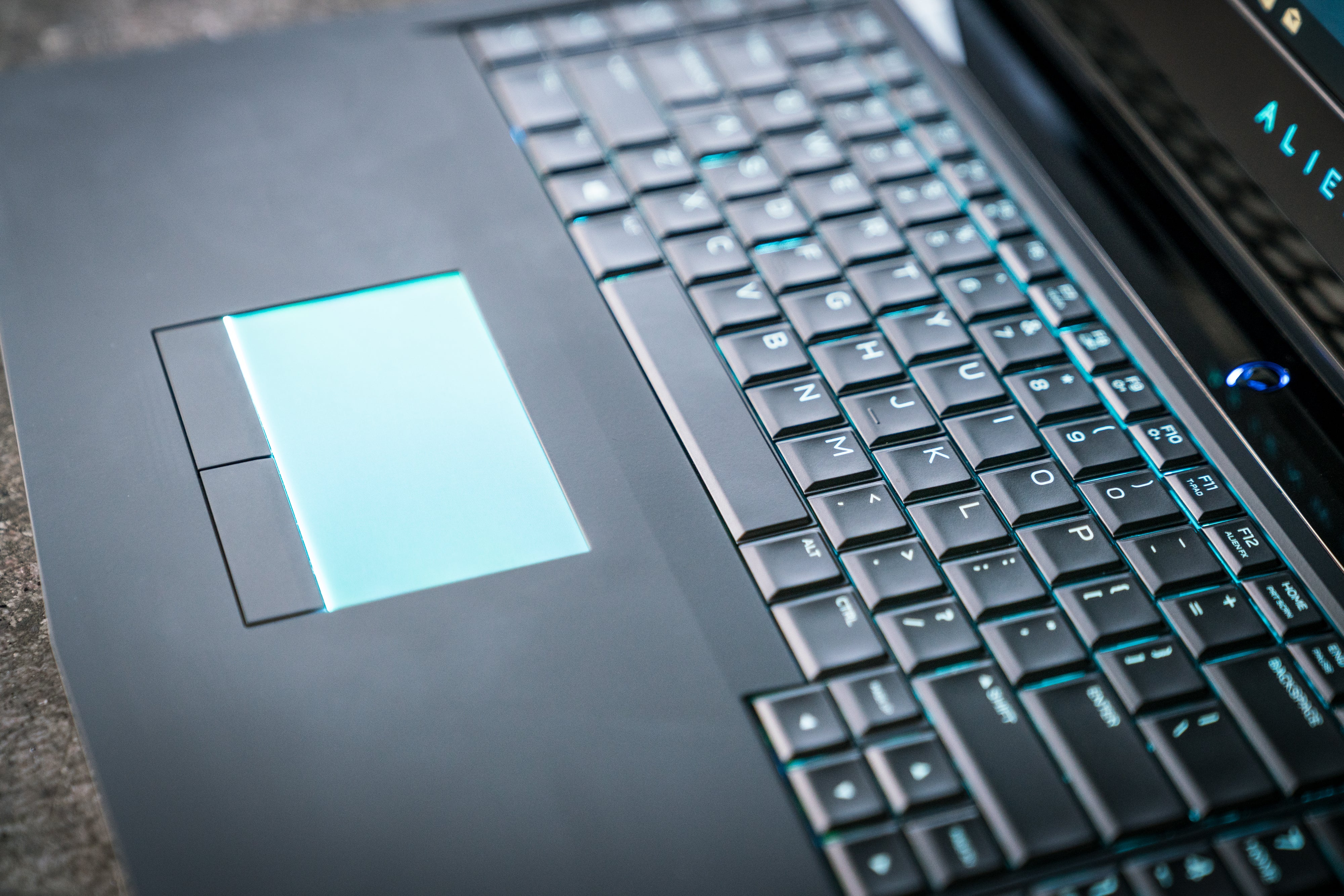
And if you love RGB LEDs, Alienware’s the competition to beat on that front. The keyboard is only zone-lit, which is a shame, but there are also RGB LED light strips embedded in both sides of the laptop and in the lid, as well as underneath the trackpad. That last bit is weirdly useful—I like a backlit keyboard, so of course I’d appreciate a backlit trackpad. The better to guide your fingers with, right? Again, flashy, but in that vaguely high-tech way only Alienware really attempts.
The display presents a tough choice for enthusiasts: The Alienware 17 comes in both 1440p and 4K models, but the 1440p version also boasts a 120Hz refresh rate and integrated G-Sync. It’s also slightly brighter, at 400 nits to the 4K model’s 300 nits. Personally I’d go for speed over resolution, especially at 17 inches, but everyone’s got different preferences, I know.
In either case, you can also opt for integrated Tobii eye-tracking. I spent a bit of time with this during my review, and have also spent time with the standalone desktop version. It’s kind of novel navigating your desktop with your eyes, and I imagine even more useful for those with disabilities, but I don’t think it’s must-have technology for the average user. As for its use in gaming, there are a few high-profile titles like Deus Ex: Mankind Divided, but it’s far from pervasive.
My two biggest complaints pertain to the rear of the machine. Instead of a normal laptop setup—which is to say, hinge at the very back—the Alienware 17 instead has the hinge set in approximately 1.25 inches.

Now, there’s a reason for this: heat. The fans all vent through this section at the rear of the chassis, meaning it gets uncomfortably warm. Not something you’d want to touch, nor something you’d want venting right next to the keyboard.
It’s ugly, though. Compared to the space-age lid, Ventilation Row looks like it was slapped on as an aftermarket part. It’s also part and parcel with the Alienware 17’s size problems, as the laptop isn’t just the size of the 17-inch screen, but that plus this fat ol’ hinge-and-vent outcropping on the back.
It’s surprisingly loud, too. I thought placing the fans behind the screen might dampen the sound a bit—if so, it’s not by much. Even under a moderate load the Alienware 17 can get noisy, and under full load (like when gaming) it all but requires a headset or headphones. On a positive note, the fans are less high-pitched and whiny than I've experienced in thin laptops like the Blade Pro, but you probably won’t appreciate the difference much when it’s drowning out your game.
My other big complaint is that power (as well as the proprietary Amplifier port, HDMI out, and ethernet) plugs into the rear vent area, on the back of the laptop. Alienware is hardly alone in this, especially when it comes to these massive desktop-replacement devices, but wow it can be annoying to try to plug in your laptop when you can’t even see the port.
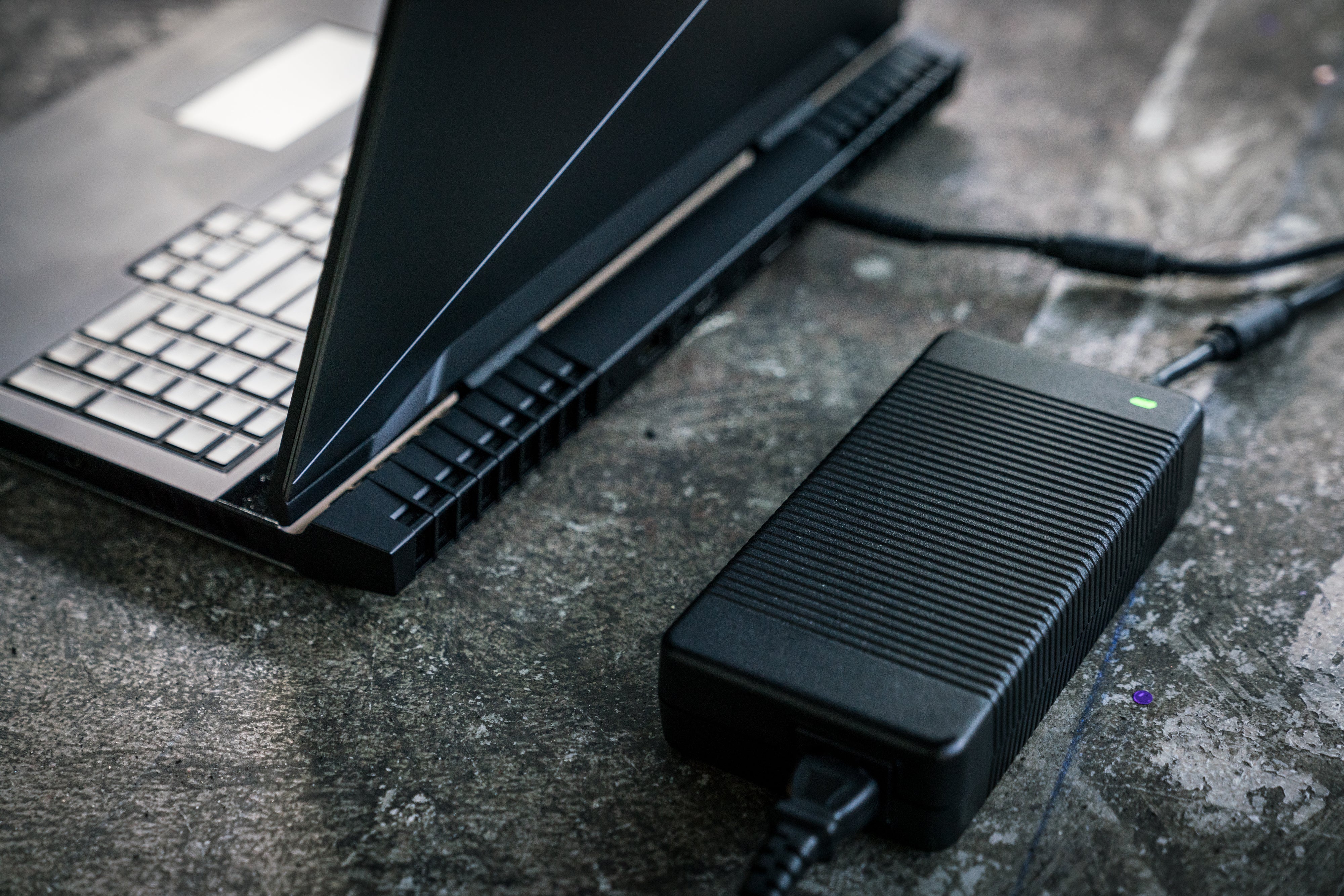
Speaking of which: The power adapter is also gigantic, adding another 2.5 pounds to your carry weight. Again, this isn’t an Alienware-specific issue, and is typical for a desktop replacement. It’s just one more contributing factor to the Alienware 17’s dubious portability. Hauling around the laptop is bad enough. Hauling around the laptop and the charger? Injurious.
It’s not optional, either. Like most gaming laptops, the Alienware 17’s excellent performance (I’ll get to that) comes at a cost: mediocre battery life. In our standard rundown test, wherein we loop a 4K video file until the battery dies, the Alienware 17 lasted 3 hours and 8 minutes under load—not bad for a laptop of this size, but certainly not enough to last you through the day.
Performance: Battle of the 1080s
It’s worth it, though. Oh goodness me, it’s worth it.
The performance gap between slim Blade Pro-style laptops and these behemoth desktop replacements has narrowed in recent years—and the competition will likely get even more fierce as Nvidia’s new Max-Q parts hit the mainstream. But there’s still nothing quite like a so-called “desktop replacement” for getting desktop-quality performance.
The Alienware 17 we reviewed came equipped with an Intel Core i7-7820HK, an Nvidia GeForce GTX 1080, and 16GB of DDR4 RAM clocked at 2,400MHz, plus 500GB of SSD storage and an additional 1TB of hard drive space. We've seen some laptops more powerful than this one, but it’s up there.
(Note: One oddity is that the Alienware 17’s baseline model comes with just a single 8GB stick of RAM. Don’t do that to yourself. Opt for at least 16GB.)
That i7-7820HK is the Alienware 17’s strongest asset. Most laptops top out at the i7-7700HQ—a perfectly respectable processor in its own right. Indeed, the difference between the two is only 100MHz, with the 7700HQ clocked at 2.8GHz (3.8GHz Turbo) and the 7820HK at 2.9GHz (3.9GHz Turbo).
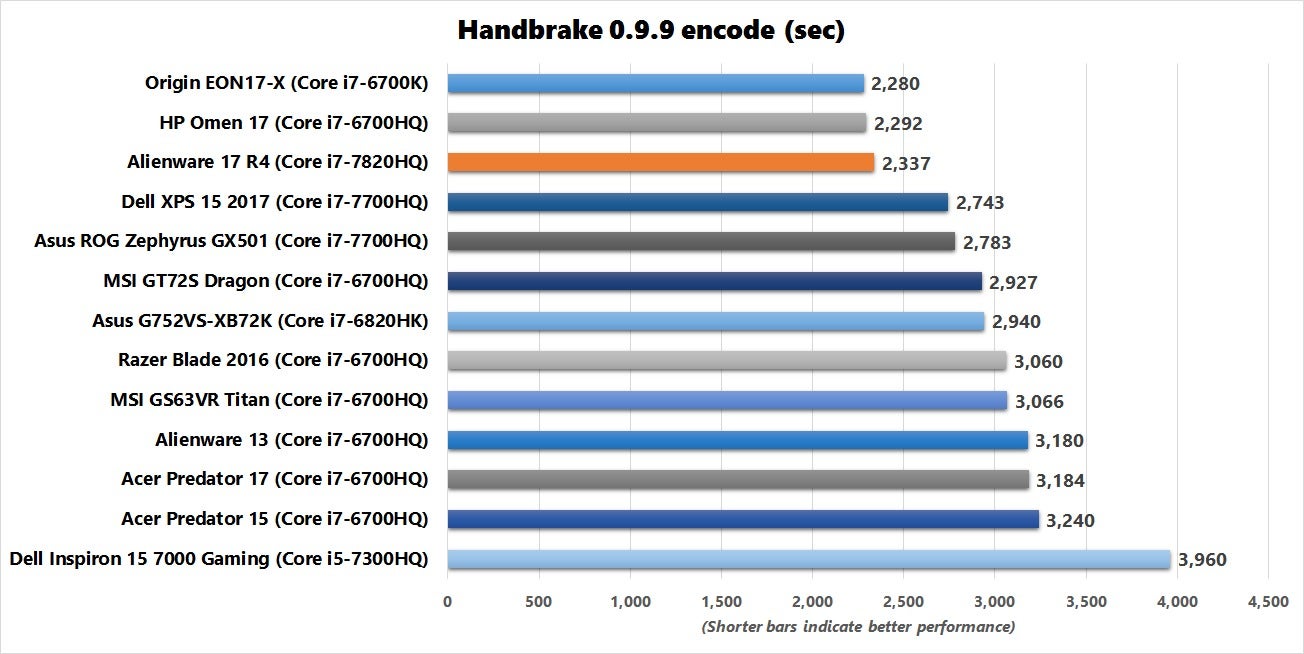
The advantage still goes to the 7820HK, though, and you can see it clearly in our Handbrake test. We feed a 30GB file through Handbrake to see how long it takes for the system to it render down to an MP4, using the Android Tablet standard—a CPU-intensive task. Our 7820HK-toting Alienware 17? A little under 39 minutes. An Alienware 15 with a 7700HQ? Almost 46, for a difference of about 7 minutes. The same goes for other 7700HQ laptops like the Gigabyte Aero 15 and the Asus ROG Zephyrus GX501.
Then there’s the GTX 1080, a powerhouse in its own right. Here we see some interesting behavior vis-a-vis Nvidia’s crop of Max-Q laptops—and the performance advantage when you buy a full-size desktop replacement like the Alienware 17.
See, in short benchmarks the Max-Q laptops match or even outpace the Alienware 17. By “short” I mean pretty much any in-game benchmark, as these typically only run for a minute or two. Looking at Rise of the Tomb Raider, for instance, you’ll see that the Alienware 17 ran at 102.2 frames per second, and Asus’s Max-Q 1080-sporting GX501 at 104.8.

The same matched-or-slightly-exceeded behavior is seen in Middle-earth: Shadow of Mordor, where the Alienware 17 posts 154.9 fps versus the GX501’s 156.7 fps. Interesting, right? If Max-Q is that good, it seems like it would completely negate the need for an oversized laptop like the Alienware 17.
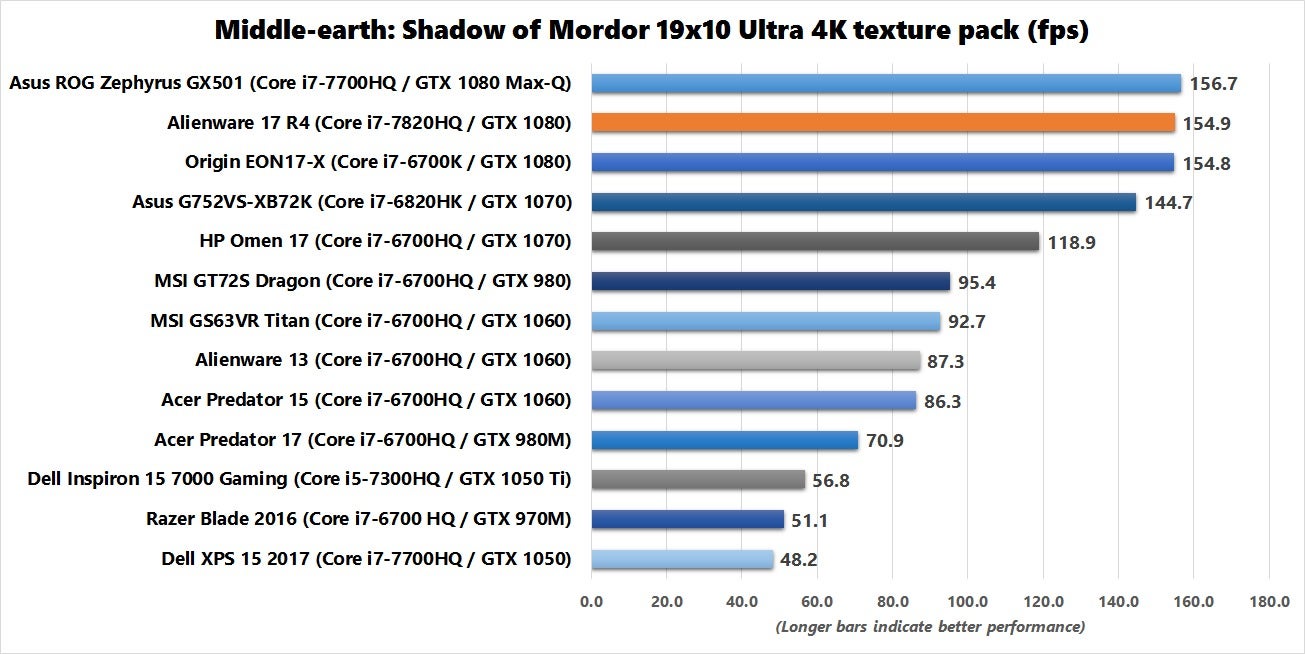
But Max-Q works only in short bursts. Remember, the key advantage to a laptop like the Alienware 17 is heat management and venting—an aspect that doesn’t make much difference in the short term but makes a huge difference in the long(er) term.
Enter 3DMark, with its longer benchmarks. Here, you consistently see the Alienware 17 outpace its Max-Q competitor. In 3DMark’s latest TimeSpy benchmark, the Alienware 17 scored a 6,538 versus the GX501’s 5,489. The same gap exists in Fire Strike Ultra, where the Alienware 17 posted 4,960 to the GX501’s 4,091.
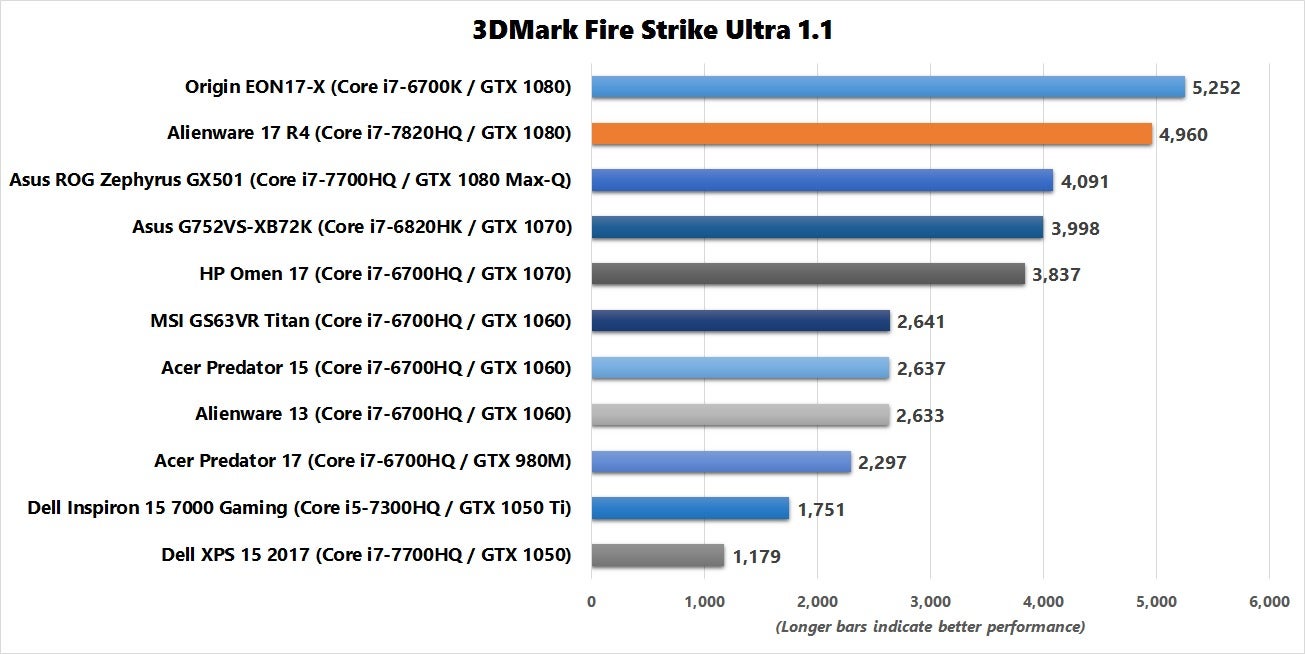
In fact, the GX501 performs more like a 1070 in these longer tests. The aforementioned Alienware 15, which packs a 1070 in addition to its i7-7700HQ, put up scores of 5,386 and 4,097 in TimeSpy and FireStrike Ultra, respectively. As my colleague Gordon Ung so succinctly put it: In Alienware’s machine, the 1080 gives you full 1080 performance all the time.
I’m not here to throw Max-Q under the bus. On the contrary, I think a Max-Q laptop with its lighter-weight design is probably more practical for most people day-to-day. Pound for pound, Max-Q has the performance edge.
Alienware gives you desktop performance, though, and under greater duress. All that heat management adds pounds, but the Alienware 17 vents like a pro, and the result is going to be better graphics, and a better and more consistentframe rate. Of course, you could do better if you opted for a desktop replacement with a desktop-class CPU, like the Origin EON17-X—but it'dl sure cost you.
Bottom line
There are rough edges. Zone backlighting is a bit outdated, the fans are loud, battery life is average, and the extra inch-plus of venting adds insult to injury in terms of the Alienware 17’s size. I’d love to see Alienware branch out and bring its unique aesthetic to a thin, lightweight Max-Q laptop one of these days.
But the Alienware 17 plays to the company’s strengths: performance, performance, performance. This machine’s got it in spades, handily outpacing what we’ve seen of the new Max-Q crop so far and proving the importance of good thermals. It’s one hell of a desktop replacement.
Subscribe to:
Posts (Atom)

-
Fantastic Beasts- The Crimes of Grindelwald - Official Comic-Con Trailer "Magic blooms only in rare souls… Still we must skulk in...
-
You might not even realize you’re eating it I can still vividly remember specific moments from my childhood. I don’t remember everything, ...
-
Can motorists transfer their no-claims discount to another as Steven Jackson did? CREDIT: WARREN SMITH Amelia Murray 28...