Saturday, August 29, 2020

The Most Memorable Red Carpet Jewelry

 We often talk about the most memorable dresses that actresses wore to a red carpet event, but as awesome as those are, a lot of the time they also wear some pretty impressive jewelry and today is the day we’re going to give it the attention it deserves. After all, these accessories are often worth a lot of money and a lot of effort went into making these shiny gems look this good. So let’s do this!

1. Beyonce, 2017 Grammys

We talk a lot about her performance at the 2017 Grammys and how incredible she looked in that gold outfit. But do you remember what she wore when she wasn’t performing that night? Beyonce definitely loves her bling and this 400-carat necklace made by Lorraine Schwartz was worth 12 million dollars.

2. Lady Gaga, 2019 Oscars

Lady Gaga wore this massive yellow diamond to the Oscars in 2019 and it almost looked more impressive than the Oscar that she won. The Value of that necklace and earrings combo is estimated at $30 million. And interestingly enough this isn’t the first time someone wore this diamond, apparently, it’s the same diamond that Audrey Hepburn had in her necklace when she was promoting Breakfast At Tiffany’s.

3. Gloria Stuart, 1998 Oscars

We all remember the massive blue heart-shaped necklace from Titanic. The movie definitely set a trend for heart-shaped necklaces for years to come. The actress, Gloria Stuart, who played the old version of Rose in Titanic wore something similar enough to the Oscars. It was a blue diamond necklace that was worth $20 million.

4. Bella Hadid, 2017 Cannes

We don’t even want to think about the price tag of a necklace like that, but let’s all agree that it’s absolutely stunning. Not many people would think to pair a pale pink dress with a massive blue rectangular sapphire but clearly, it works. Then again, we’re pretty sure that a sapphire like that works with anything, especially if Bella is wearing it.

5. Rihanna, 2014 Diamond Ball

Rihanna knows how to dress to impress, that’s for sure. We loved the pink ensemble she wore to the Diamond Ball in 2014. What’s hard to tell is what’s more impressive, the massive pink tear-shaped rubellite or all the diamonds encrusted on the necklace. It’s definitely a work of art.

6. Sofia Vergara, 2013 Emmys

When you’re Sophia Vergara, you won’t be satisfied with just wearing one kind of gemstone. You have to wear them all, at once if possible. So she really did wear ruby, sapphire and emerald earrings to the Emmys. And then she chose to wear a diamond ring on each hand for good measure.

7. Emily Ratajkowski, 2017 Cannes

Emily also likes to dress up to the nines so to the 2017 Cannes Film Festival she wore this elaborate Bulgari necklace that featured rubies, diamonds and even an emerald. You gotta give her props, it’s quite a big and colorful necklace to pull off, but wearing it with a simple cream silk dress was definitely a great move.

8. Gal Gadot, 2019 Oscars

Wonder Woman, sorry, we mean Gal Gadot, really glammed up for the 2019 Oscars and wore a very art-deco necklace as her main accessory. It was a piece made by Tiffany and it actually features 1000 diamonds.

9. Margot Robbie, 2015 Oscars

Margot Robbie definitely looked stunning at the 2015 Oscars. That chunky necklace she’s wearing is so cool it has its own name. It’s called Zip Antique Columbine and it features sapphires and diamonds encrusted in gold. Oh, and yeah, that zip is fully functional.

10. Greta Gerwig, 2020 Oscars

This year’s Oscars were full of awesome accessories, but Greta Gerwig, the director of Little Woman wore a necklace that just mesmerized us. It featured 9 emeralds surrounded by 49 diamonds. It just looked so good and went so well with her greed dress!

Source : Youngsters

How to Tell if Someone Values You.

How to Tell if Someone Values You. 

They Will Do Most, If Not All of the Following.

They offer you their generally undivided focus and attention, the majority of the time you are in their company.

They return your phone calls and texts in a timely manner.

They do not routinely cancel on you.

They are not frequently late in a significant way.

They showcase a sense of openness and interest toward your life pursuits, passions, emotional experiences, and happenings.

They prioritize and make a point to spend time with you.

They don’t regularly leave you hanging.

They are interested in listening to and learning about who you are. Their actions will make this obvious.

They laugh with you.

They apologize when they mess up with you (and, you do the same with them).

They partake, at least a little bit, in the things that are important to you. Whether it’s attending your poetry reading or coming to hear your band play, reading your writing, inquiring about your latest cool project at work, listening to you recollect the wonderful time you had recently with a close friend, taking the time to hear about your children, you get the idea. They don’t have to do this all the time, or even a ton, but they should do it to a decent degree.

They are willing to compromise, to try places and things that you like or suggest (and, you should do the same with them as well).

They are trustworthy. You can feel confident and safe that the things you disclose to and confide in them will remain between the two of you unless otherwise specified.

They do not attempt to bully, manipulate, stronghold, or betray you.

They notice and thank you for the things you do, with and for them.

They pay attention to what’s happening in your life, to the things you love and loathe. They recall these.

They remember your birthday and other significant occasions (the first day of your new job and such).

They put down their phone, away entirely, when in your company. And they leave it away.

In short, it’s quite plain when a person values you. We often make this out to be something challenging and unclear, a thing that’s difficult to figure out and decipher.

It isn’t.

When a person holds you in respected and valued esteem, you won’t really have to wonder. Instead, you know it.

Source : Youngsters

Your Relationship Will Improve If You Stop Texting This One Way

Your Relationship Will Improve If You Stop Texting This One Way 

Use it for information, not communication.

A couple of years ago, my now husband and I attended a workshop for couples aptly titled “Rules of Engagement.” It would be at this very workshop where we’d learn something that would change how we both viewed texting and help improve communication within our relationship.

At least twenty couples were present at this workshop, all of different ages, races, ethnicities, religions, and orientations. Some were engaged, and some, like my partner and I, weren’t engaged yet, but in talks about marriage. Some also, like my partner and I, weren’t on their first marriage.

My skin prickled with nervousness as I scanned the room. There’s nothing like one failed marriage to make you wonder if you’ll have a second one in your future. My partner, sensing how tense I’d become, set his hand on my leg.

The moderator began with a doozy: “The person sitting next to you will be the person that makes you grow the most in your entire life. You’ll love them. You’ll hate them, but you’ll either grow together, or you’ll grow apart.”

I turned and looked at my partner and gave him a bit of a half-smile.

Then the moderator began with the first topic: communication. He scanned his eyes over the crowd of couples and said,

“When you text, use it for information, NOT communication.”

A few couples met each other’s eyes and laughed. We were one of them.

The difference, the moderator explained, is this:

“I’ll be there at 7.” (information)

vs.

“I hate how your mother always criticizes my parenting. It’s like she thinks I’m a terrible mother.” (communication)

“Things are always lost when you communicate over text, so don’t do it. Wait until you’re in front of each other. Look into each other’s eyes and tell your partner you don’t like how their mother talks to you. Do not do it over a text message.”

“You,” my partner said, taking my hand, “are the worst at that.”

I looked down sheepishly. I had to admit he was right.

Every person has likely committed this error at least once (or, if you’re like me, buckets of times). Texting is an easy way to connect with our loved ones when we’re away from them.

That moderator was right. There is so much lost when we text. The other person can’t see our facial expressions or our body language or hear how we’re voicing certain things. Without those things in place to flesh out how they should take something, they can fill in the gaps with awfulness and then you’ve got an unnecessary squabble on your hands.

UCLA professor Albert Mehrabian found that 55% of communication is through body language, 38% through vocal tone, pitch, and emphasis, and a mere 7% through words.

The reason why only 7% of our communication is based on words is because sometimes our words don’t match our body language.

Here’s an example: “I don’t have a problem with it,” you say, but your jaw is clenched and your arms are crossed over your chest. Your body language is clearly not matching your words. If you’d just texted that information, your partner wouldn’t know that you, in fact, did have a problem with it, and I bet your partner would be in for a world of fun when you met up.

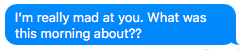
Image for post
Photo by the author

I, too often, have tried to use texts for communication instead of information. The photo I include above of a text message is a real one from a real conversation I attempted to have with my partner while he and I were both at work. Needless to say, I made things a lot worse by trying to do that over text.

Many people, like myself, choose to text these kind of things because it seems easier. Our phones are always within reach while our loved ones are not.

We also may want things settled now because we’re impulsive. I know when I’m feeling such a way, I want my partner to know now. Plus, my partner and I can be apart for twelve hours at a time, so that can feel like forever.

Further, I don’t like communicating my feelings in person. It makes me feel uncomfortable and vulnerable, and I don’t want to do that in front of anyone, even if it is my forever someone. Also as a writer, I just prefer to write over talk. Writing means I can delete, shape, and re-think things before sending them, while I can’t press “delete” once something has left my lips.

That workshop taught me, though, that it must be something I actively work on. There have been a few occasions now over the years where one of us has said to the other, “Hey, I think it’d be best if we waited to talk about this until later. Remember? Information, not communication?

We all want and deserve happier and healthier relationships, and if we could get that by giving up something as seemingly small as not sharing our feelings over text, why not do it? It could lead to you and your partner having the kind of intimacy and understanding you’d both want.

Source : Youngsters

Are Life Partners the New Marriage?

Are Life Partners the New Marriage?


On non-monogamy, commitment, and freedom.

I’ve seen more people than ever stating that they’re looking for a “non-monogamous” relationship. In dating app bios, general conversation, and on actual dates, I’m amazed at how many men I’ve encountered over the past year who specify this. They say that they’re fine with long-term just not exclusive relationships. And though I appreciate the honesty, it’s not the norm to which we’ve grown accustomed, so it seems odd.

What’s happening? Is this the new normal?

Even megastars Will and Jada Pinkett-Smith recently let it be known that they don’t consider themselves married anymore, but . For them, this means that they’ve committed to supporting one another until the end of their days and neither will have to want for anything as long as the other is alive. The couple didn’t say explicitly that they’re nonexclusive, and even denounced the idea of an open marriage — but they made it clear that romantic fidelity is not the basis of their union.

I suppose our perspective depends on where we place the greatest emphasis. There are many more heartbreaks and betrayals that can be inflicted upon us by a partner than cheating. But traditionally, monogamy has been a foundation of committed relationships, and especially marriage.

Certainly, many additional factors go into the declining marriage  and increasing cohabitation rate in the United States than wanting to sleep with other people. However, the idea of non-monogamy, and more importantly, the recent boldness in pursuing it must be an element. Expressing a desire to have multiple sex partners used to be frowned upon and reduced to being nasty or a whore. It still carries a negative connotation with some, but the perception overall has softened.

To some, non-monogamy is about freedom and autonomy.

One guy explained to me that he’s no longer interested in exclusivity because he feels it creates, for him, unrealistic demands and expectations. He sees being forthcoming with himself and others about his wants as integrous.

Younger generations seem less interested in avowing to one person for eternity. In fact, speaking of the Smiths, Will and Jada’s daughter Willow said that she views this as ownership — which to her is unappealing.

“Monogamy, I feel — this is just personally, just for me — I feel actually inhibits you from learning those skills of evolving past those feelings of insecurity,” Willow said.

The youngest Smith views monogamy as “too restricting,” but is careful to point out that it’s not because she’s constantly seeking new sexual experiences. She craves emotional connection but doesn’t want the anxiety and jealousy that often come with viewing someone as “your person.”

Willow isn’t alone.  suggests that more people than ever in the United States are or have been engaged in consensually non-monogamous relationships.

Elisabeth A. Sheff, Ph.D., said:

While it seems highly unlikely that CNM will replace serial monogamy any time soon, it certainly has taken a place alongside singleness, monogamy, and cheating in the menu of possible relationship options.

My life experience and exploration support this theory.

Perhaps we’re actually trying to be better partners by declaring intent upfront instead of attempting to meet a relationship ideal with which we struggle or don’t wish to live up to. I’d much rather someone say from the beginning that they’re not interested in monogamy and allow me to make an informed decision when the alternative is deception.

So, I don’t have an issue with this evolving trend of men I’ve witnessed specifying a desire for non-monogamy. The concept doesn’t interest me but to each his/her own. I respect the transparency.


I’m in favor of consenting adults doing what makes them happy. Also, “life partner” is a fitting term for those who simply don’t wish to, or can’t marry. It isn’t synonymous with non-monogamy. Yet, I wonder if the idea is replacing the institution of marriage.

Love remains the #1 reason people decide to wed.

There are several logical  many may decide not to tie the knot. Among them are a reluctance to enter a legally-binding union and concerns over finances. Others just consider it an outdated, obsolete tradition.

Opting out of marriage doesn’t mean that there is no commitment. Just as we all know that husbands and wives commit adultery all the time. These are only titles. It’s up to us to give them meaning. The growing popularity of non-monogamy and life-partnerships just speaks to our changing relationship landscape. I don’t know that “change” in this case is synonymous with erosion, however.

Some associate a desire for non-monogamy with a lack of self-control or values. Some equate marriage with love, and if a partner doesn’t want this, think it means they don’t care for them enough. But I can’t say that monogamy or marriage is inherently better than the opposite. I’ve just noticed a shift — in the way that we present ourselves to dating prospects and the comfort with embracing concepts that the majority may consider unsavory.

In essence, perhaps the process has become more authentic.

Source : Readitworld

A Bowl Of Oats A Day To Keep The Doctor Away

A Bowl Of Oats A Day To Keep The Doctor Away

You’ve probably been told that oats are good for you. Trouble is, you know they’re a bland, tasteless grain. Don’t get me started on overnight oats either — there’s nothing appetizing about a cold sloppy mess. Despite my clear prejudice, I just couldn’t ignore the health benefits. It turns out all I had to do was learn how to spice up these little nutrient dense grains. I’ve had a bowl every day since.


What is an Oat?


Health Benefits

How To Make Delicious Oatmeal

Source : Youngsters

8 Things To Know If You’re In A Relationship With An Empath

 8 Things To Know If You’re In A Relationship With An Empath

How to love a highly sensitive, empathetic person.

Empaths are unique in many ways, both positive and negative. One thing is certain: after dating one, your life will never be the same.

Being in a relationship with an empath is a wonderful, challenging experience. Wonderful because life gains a whole new meaning when you’re loved by someone so caring and sensitive. Challenging because empaths don’t take love lightly and things can get extremely intense.

As an empath, I’m aware of my strengths and vulnerabilities. I know I can be too sensitive at times. But I have also learned that my sensitivity is precisely one of my strengths — not one of my weaknesses.

We empaths are highly attuned to our environment and to the people we share our life with. Being with the right person — someone who adores us and values our particular traits — plays a huge role in our well-being.

If you’re in love with an empath, these are some things to keep in mind if you want your relationship to flourish and reach its fullest potential.


1. Our alone time is non-negotiable

Relationships are important to us. We thrive when we’re surrounded by people who truly respect us and love us for who we are.

However, we are lone wolves. We need our downtime as no one else does. We tend to absorb our partner’s energy, and become overwhelmed, anxious, or exhausted when we don’t have time to decompress in our own space.

It’s not a luxury; it’s about self-preservation. I feel suffocated and disrespected when I’m not given my space to breathe and recharge, and I’m at my best when I have that time for myself.

2. Be sensitive about how you express yourself

Empaths usually think twice before saying or doing anything. We’re extremely careful when expressing our feelings and opinions because we don’t want to hurt anyone with our words — and we expect the same in return.

Keep in mind that we get easily hurt by criticism and judgement. We can’t just “shrug things off”. So, if you say something that causes damage, there’s no going back. We’ll feel sad and overwhelmed by our emotions for hours.

3. We can’t stand shallowness

Understanding an empath requires an incredible amount of empathy, and connecting with us is something most people we date are unable to do.

Everything we feel is deep, and that includes our love for you — it’s as real, raw and pure as it can be.

“The sort of love that awakens all the cells in your body is the norm for us. It has such intensity that it slows down time, makes you feel like a million bucks, and reminds you what’s important in life. I’m talking about THAT kind of love. I’m not saying it lasts forever, especially in long-term relationships, but you’re almost sure to experience it if we fall in love with you.”

Ginelle Testa, in Love Is Intense For Everyone, But For Empaths, It’s Out Of This World

4. Believe in us, and verbalize it

Empaths are creative souls. We have a million dreams, visions, and aspirations, and we love to fantasize about them.

Although it can be beneficial for us to be with someone who’s more down-to-earth, it’s important to find a compromise. We’re at our best when our partner believes in our abilities and helps us make our dreams come true. When this doesn’t happen, we feel devalued and invalidated.

5. Allow us to express our emotions freely

We wear our hearts on our sleeves. We feel a lot, and we feel intensely. It can be tempting to tell us to ‘let it go’ and focus on something else, but this is not something we can easily do.

Don’t try to change us. Don’t tell us we’re too sensitive — we’re perfectly aware of that and we work really hard to accept ourselves. We’re our own worst critics and we don’t need any more judgement.

The best thing you can do is to comfort us and support us through these difficult moments and phases, and we’ll forever be grateful.

6. Don’t force us to socialize when we don’t want to

Now, I’m at a point in my life where I know my boundaries and I respect my emotional needs. But usually, empaths do their best to please everyone and it can take a long time for us to learn how to put ourselves first.

We love to socialize and to spend time with those who are important to us. However, as I’ve mentioned, we also need our downtime to unwind.

If sometimes we don’t feel like going out, then please respect that. It’s nothing personal. We’re probably just trying to recharge and process our emotions.

7. Be always honest — we know when you’re lying

Our intuition is usually spot on. We know when you’re speaking the truth — we may choose to look the other way because we love you and we have the habit of seeing the good in others, but believe me, we know.

If you want to avoid conflict, just tell us the raw truth in a kind, considerate way. Heck, there’s no one more understanding and compassionate than us (which can be one of our flaws sometimes!), so there’s no point in lying to us.

8. Our hearts are constantly broken

“An empath’s heart is constantly broken by injustice, by inequalities, by the amount of toxicity in others and by being hurt by people. So, the least of your worries will be that you’ll ever get hurt by an empath. They are very aware of the pain in this world and that’s why they’ll do anything they can to protect your heart. You won’t have to worry that you’ll be cheated on, that they’ll ghost on you or anything like that because, when it comes to empaths, they always put your needs before theirs.”

Maria Parker, in 8 Ways Empaths Love Differently


Empaths are highly sensitive souls who are easily misunderstood. We’re giving, loving, compassionate, and sometimes, extremely anxious.

Being in an intimate relationship with an empath is like experiencing love from another planet.

You’ll probably catch yourself wondering what is it that you did to deserve to be loved in such a special way, and the answer is: probably not much. But it doesn’t matter. Don’t wonder where you got it from. Accept it and embrace it.

Source : Youngsters

5 Simple Mistakes New Runners Need To Stop Making

 5 Simple Mistakes New Runners Need To Stop Making

Avoid these common pitfall most newbie runners make

1. Analysis Paralysis

I have a friend who spends more time planning and preparing than doing the actual activity that will make him healthier.

Most people looking to get in better shape will generally experience some sort of ‘analysis paralysis’ — a state of overanalyzing or overthinking a situation so much that it causes you to become “paralyzed” in making a decision. This state of mind will limit your ability to take action instead of just doing it.

The best place to start is always with what you have. You don’t need any fancy running shoes, clothes or gadgets. Just put on your favorite pair of shoes and do it.

The first time is always going to be uncomfortable. No amount of planning, purchasing, or prepping will prepare you for that. There’s no substitute for just doing it.

So don’t get paralyzed searching for the latest shoes, shirts, or gadgets. Just go out and run. Eventually, better gear may help. But don’t let the lack of it be what stops you from getting started in the first place.

2. “I don’t like working out.”

Most of us generally understand how to get in better shape: Eat better, workout more.

While the strategy is pretty simple, it’s not always easy to follow it. Whether it’s fear of failure or embarrassment or general misunderstanding, I constantly hear excuses as to why people can’t get in shape.

“I don’t like working out.” is the king-daddy of them all.

There are always going to be things in life that we don’t like to do. Oftentimes, it’s these things we don’t like to do that provide us with the most benefit of all. And working out is no different.

Treat it like a job. Or like a shower. Or just treat it like something you have to get in every day (or every other day), regardless of what’s going on in your life.

Whatever the strategy, treat it as it is — something to keep your body and mind running in tip-top shape.

I don’t know many people that go more than a day without showering. So why do we go weeks, sometimes even months, without working out?

3. “But where/how do I start?”

To get healthier you have to start where you are. You have to do what you can, with what you’re given.

  • If you can’t run 10 miles, run one instead.
  • If you can’t run a mile, fine, go for a walk around the neighborhood instead.
  • If you can’t walk, fine, try just standing up out of the chair 5 times.

Everyone is in a different spot — different circumstances, different situations, different energies — but that doesn’t mean you can’t do something.

To get in better shape, you have to start somewhere. You have to start where you’re at, with what you’re given. That could mean just taking the stairs at work, opting for the salad at lunch, or going for some evening walks with your spouse after dinner.

4. Waiting for the Perfect Moment

People who want to get in shape are constantly waiting for the conditions to be perfect. For the stars to align and the motivation to kick them in the butt and drive them forward.

It’s totally understandable. It’s hard starting something new, let alone trying to change your habits and body all in one go of it. Perfect conditions would be ideal.

But, this mentality isn’t going to work because the perfect moment won’t ever come. It’s a fantasy. A hoax. Things are NEVER going to be perfect when you’re getting started.

The conditions will never be perfect. It’s going to be difficult whether you start now or Monday morning. You’ll sweat just as much, feel just as sore, and struggle just the same.

The only difference between starting now and Monday morning is that you’ll feel better and more confident come Monday if you started today.

5. Fully Commit

Before you lift one dumbbell, take one step or start a single workout, you first have to commit to actually making a change.

If you really want to make a change — whether it’s getting healthier, feeling better, or even getting abs — you have to be willing to give something up.

It’s not enough to just say you want to get in better shape. You have to be willing to actually make a change in your life.

Nothing changes if nothing changes.

  • It could be exercising 30 minutes a day, 4x per week. That’s a big change.
  • It could be swapping takeout for lunch with a salad you brought from home. That’s a big change.
  • It could be refusing to buy junk food at the store. That’s a big change.

Whatever it it is, no matter how big or small, in order to change your body, you first have to be willing to change your lifestyle.

Source : Youngsters

This 8-Word Meditation Changed My Life


In, out. Deep, slow. Calm, ease. Smile, release.

In2015, I fell on hard times. I was in a downward spiral; the worse things got, the more I obsessed over prior misfortunes. Eckhart Tolle calls this phenomenon “the pain-body”: a state of compulsively seeking turmoil, even if it means hurting others. Your pain-body thrives on conflict and misery, so it demands that you experience anger, shame, and hopelessness as viscerally as possible.

Tolle has explained the pain-body as follows:

It has two modes of being: dormant and active. A pain-body may be dormant 90 percent of the time; in a deeply unhappy person, though, it may be active up to 100 percent of the time. Some people live almost entirely through their pain-body, while others may experience it only in certain situations, such as intimate relationships, or situations linked with past loss or abandonment, physical or emotional hurt, and so on.

Anything can trigger it, particularly if it resonates with a pain pattern from your past. When it is ready to awaken from its dormant stage, even a thought or an innocent remark made by someone close to you can activate it.

When my pain-body took over, I began to relive painful memories.

This “intrusive re-experiencing” was excruciating.

I thought about the worst moments of my life hundreds of times every day.

Therapy and exercise helped, but I needed something else.

So, five years ago, I read You Are Here: Discovering the Magic of the Present Moment.

It’s kind of like a manual for day-to-day living, written by a Buddhist monk named Thich Nhat Hanh.

It helped, and I highly recommend it.

You can buy it online for $6.

What I want to highlight today is a meditation Hanh prescribes for people feeling overwhelmed. Some call it a “meditation poem.”

It’s very short:

In, out.

Deep, slow.

Calm, ease.

Smile, release.

Per Hanh’s instructions, I practiced reciting the poem in my mind while I breathed. As I inhaled, I would focus on the word “In.” As I exhaled, “Out.” Inhale, “Deep.” Exhale, “Slow.” You get the idea.

You don’t even have to worry about modulating your breathing.

In fact, Buddhist practice is generally to let your breath do what it wants to do during meditation.

But you will find that the mere act of monitoring your breath causes you to breathe gently.


When my thoughts were chaotic and unmanageable, Thich Nhat Hanh’s poem really helped me soothe my mind. I would sometimes imagine that I was inhaling cool air directly into my brain. I could relax, I could focus, and I could sleep better.

And you can breathe into any other source of tension in the body. Whatever ails you — your back, your joints, your stomach — try to inhale directly into the pain or discomfort.

You’ll find that you can manage the sensation, even if you still need medical care to treat the underlying cause.

Hanh’s meditation poem is the most portable life-enhancing tool I’ve ever encountered. It’s easy to memorize, and it’s very effective. You can incorporate it into your daily life without setting aside time for meditation, and I hope you will. My mind has been a calmer place since I did so.

“The most precious gift we can offer others is our presence. When mindfulness embraces those we love, they will bloom like flowers.” — Thich Nhat Hanh

Source : Readitworld

The Last Time I Had Sex With My Wife


For anything new to begin, something must first end.

Not The Life We Imagined

A Home Into A House

The Final Time

Source : Readitworld

Our Love For Keanu Reeves Highlights Double-Standards For Men and Women


Source : Youngsters